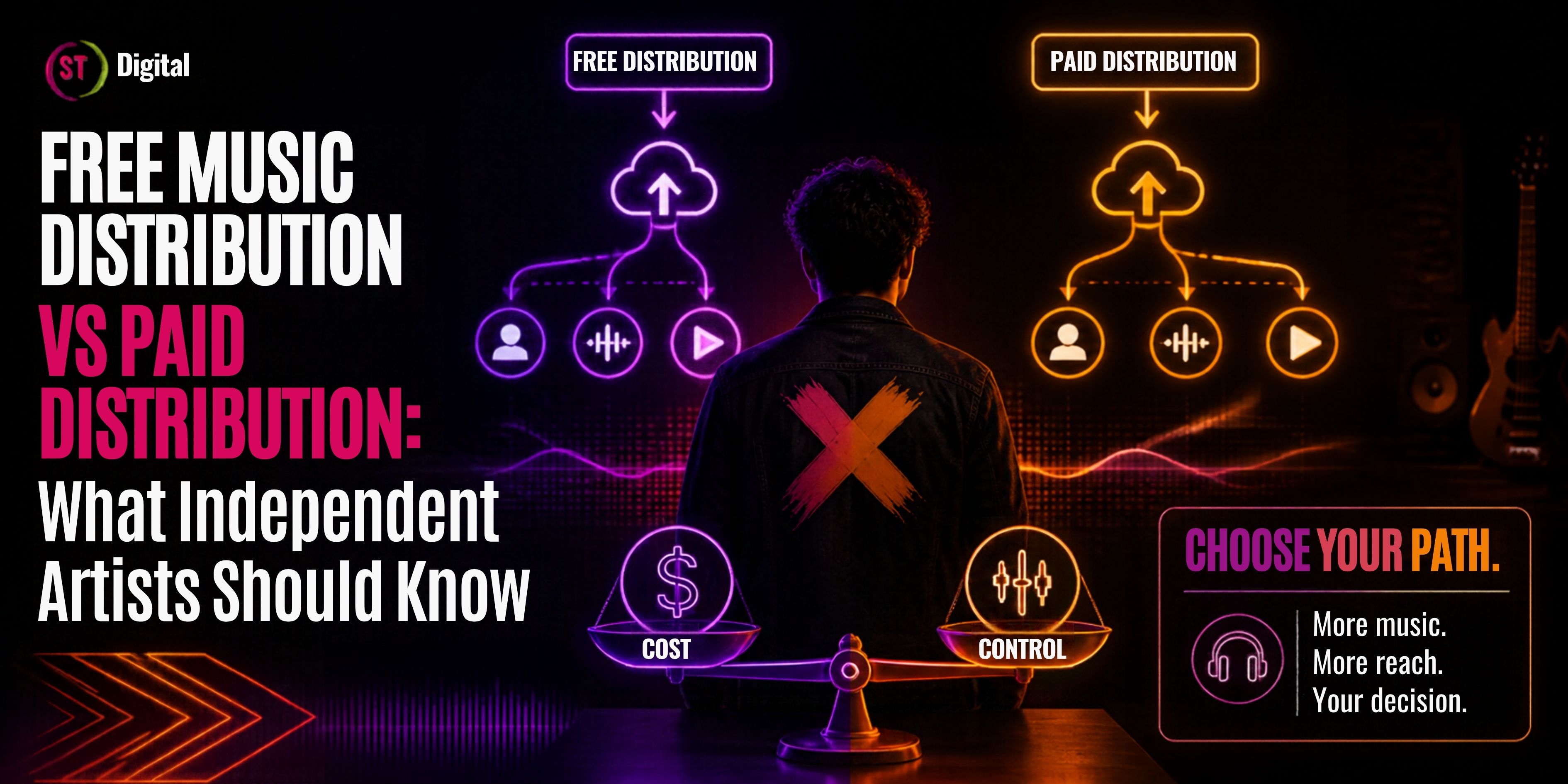
Releasing music independently has become easier than ever. Artists can now distribute singles, EPs and albums to digital streaming platforms without signing with a traditional record label. However, before releasing a song, one important decision remains: should you choose free music distribution or pay for a distribution service?
Both options can help independent artists make their music available to listeners around the world. The main differences usually involve upfront costs, subscription fees, royalty-sharing arrangements, additional services, customer support and release-management features.
Choosing the right option is not simply about finding the cheapest distributor. It is about understanding the terms, protecting your rights and selecting a service that fits your music career.
In this guide, we will compare free vs paid music distribution, explain the advantages and disadvantages of each model, and help you decide which option makes sense for your next release.
What Is Music Distribution?
Music distribution is the process of delivering recorded music to digital streaming services and online music stores. A digital distributor helps artists submit their recordings, cover artwork, metadata and release information to supported platforms.
These platforms may include Spotify, Apple Music, YouTube Music, Amazon Music, JioSaavn and other regional or international services, depending on the distributor's network.
Instead of submitting music separately to every service, artists can use a distribution company to manage delivery across multiple platforms.
If you are new to the process, read our guide to music distribution without a record label to understand how independent artists can release music while managing their own careers.
What Is Free Music Distribution?
Free music distribution allows artists to submit eligible releases to supported digital platforms without paying an upfront distribution fee. Depending on the provider, artists may also receive royalty reporting, release management and access to international music stores.
However, the word free does not automatically mean that every service is included without conditions. Some distributors offer a free plan but retain a percentage of royalties, restrict certain features or charge separately for optional services.
Other providers advertise free distribution without upfront fees, subject to their eligibility requirements and distribution agreement.
Advantages of free music distribution
1. No upfront distribution cost
Artists can release music without paying an initial distribution fee. This is particularly helpful for beginners who need to manage recording, mixing, mastering, artwork and promotion expenses.
2. Lower financial risk
If you are testing a new sound or releasing your first single, avoiding an upfront distribution expense can make experimentation more affordable.
3. An opportunity to build an audience
Free distribution can help artists publish music consistently, learn how streaming platforms work and start building an audience before investing in additional services.
4. Access to multiple music platforms
Depending on the distributor and selected plan, a free service may deliver music to multiple streaming platforms in India and internationally.
5. More budget for music promotion
Money saved on distribution can be allocated to a music video, social media content, advertising, public relations or other promotional activities.
Potential disadvantages of free music distribution
Free services may have limitations, depending on their business model.
Some providers retain a percentage of eligible royalties.
Certain advanced promotional or analytics features may require an additional payment.
Customer support options may vary between providers.
Some plans may impose eligibility requirements, release limits or restrictions on specific services.
Terms for takedowns, account closure and catalog transfers may differ.
These limitations do not apply to every free distributor. Always review the actual plan and agreement rather than making a decision based on the word “free” alone.
What Is Paid Music Distribution?
Paid music distribution generally requires an artist to pay a subscription, a per-release fee or another agreed service charge. In return, the distributor may provide distribution services and additional tools, depending on the plan.
Some paid services charge annually for access to distribution. Others charge separately for each single, EP or album. Certain plans may also include premium support, expanded analytics or release-management features.
Importantly, paying for distribution does not automatically guarantee better streaming numbers, playlist placements or higher royalties.
Advantages of paid music distribution
1. Predictable service costs
A fixed subscription or release fee can make expenses easier to plan, particularly for artists who release music regularly.
2. Potential access to additional tools
Some paid plans offer features such as advanced reporting, promotional tools, smart links, collaboration options or additional release-management features. The actual benefits depend on the provider.
3. Options for frequent releases
Artists who publish singles regularly may find a subscription model more convenient than paying separately for each release. However, they should compare the total annual cost and any release restrictions.
4. Services tailored to established artists
Artists with a growing catalog or more complex release schedules may benefit from specific paid features, provided those features solve a genuine business need.
Potential disadvantages of paid music distribution
Annual subscriptions can become expensive over time.
Per-release fees can add up when releasing music frequently.
Some plans may require continued payment to maintain particular services.
Additional features may not be useful to every artist.
Paying a fee does not guarantee streams, playlist placements or commercial success.
Before subscribing, confirm what happens to your releases if you stop paying, whether your music remains available, and whether any additional fees apply.
Free vs Paid Music Distribution: Key Differences
The following comparison explains the common differences between the two models. Individual distributors may use different pricing structures and terms.
FactorFree DistributionPaid DistributionUpfront costOften zeroSubscription or release fee may applyRoyalty arrangementMay be commission-based or offer a different modelMay offer a different revenue split or fee structurePlatform reachDepends on the distributor and planDepends on the distributor and planRelease frequencyDepends on eligibility and restrictionsDepends on the subscription or release termsAnalyticsBasic or advanced, depending on providerAdvanced features may be includedCustomer supportVaries by providerPremium support may be availablePromotional toolsMay be limited or optionalAdditional tools may be includedBest suited forBeginners and budget-conscious artistsArtists who benefit from specific paid featuresMain considerationRoyalty share and service limitationsTotal cost and value of included services
The most important lesson is that free distribution is not always more affordable, and paid distribution is not always more valuable. The right choice depends on the complete agreement and the services you actually need.
How Do Distributors Make Money?
Understanding a distributor's business model can help you evaluate whether a free or paid plan offers better value.
1. Revenue-sharing model
Under a revenue-sharing model, a distributor may retain an agreed percentage of the revenue covered by the contract. The artist receives the remaining amount according to the applicable terms.
For example, if a hypothetical agreement allocates 90% of eligible distribution revenue to an artist and 10% to the distributor, the distributor's share is calculated according to that agreement.
The actual amount an artist receives also depends on platform reporting, applicable deductions, rights arrangements and the definition of revenue in the contract.
2. Subscription model
A distributor may charge a recurring fee for access to its service. The subscription might cover one or more releases, depending on the plan.
Artists should check renewal dates, annual costs, cancellation conditions and what happens to their catalog if a subscription expires.
3. Per-release pricing
Some distributors charge a separate fee for each single, EP or album. This can work for artists who release infrequently, but costs should be calculated over an entire year if several releases are planned.
4. Optional paid services
Some providers offer extra services, such as promotional campaigns, additional reporting tools, video distribution or other rights-management services.
Before purchasing an add-on, confirm its exact scope, eligibility conditions and whether it is necessary for your release.
Do Free and Paid Distributors Pay the Same Royalties?
Not necessarily. There is no universal royalty rate that applies to every distributor or every streaming platform.
Streaming revenue depends on several factors, including the platform's revenue model, listener location, subscription type, stream share, applicable rights and the agreements governing payment.
A distributor then accounts for revenue according to its agreement with the artist.
Spotify explains its royalty system in its official Royalties Guide for Artists. It describes how recording and publishing royalties flow through rightsholders and how the agreements between those parties affect the amount artists ultimately receive.
When comparing distributors, check:
What percentage of eligible revenue you receive.
Whether the distributor retains a commission.
Which revenue streams are covered by the agreement.
Whether any withdrawal, payment-processing or administrative fees apply.
Minimum payout thresholds and payment schedules.
Whether video monetization, user-generated content or other services have separate terms.
Do not choose a distributor solely because it advertises a high royalty percentage. A transparent agreement and reliable reporting are equally important.
Which Is Better for Beginners: Free or Paid Music Distribution?
For many first-time artists, free music distribution is a practical starting point because it reduces upfront costs.
A beginner may need to spend money on recording, mixing, mastering, cover artwork and promotion. Avoiding an unnecessary distribution expense can help keep the overall release budget manageable.
Free distribution can be especially useful for:
First-time singers and songwriters.
Independent rappers and hip-hop artists.
Regional-language musicians.
Devotional and folk music creators.
Bedroom producers and independent composers.
Artists who are testing audience interest in a new genre.
However, a free plan is only suitable when its terms, platform availability and features match your requirements.
If a paid plan provides a specific feature that you genuinely need, compare its cost with the benefits before deciding.
When Should an Independent Artist Choose Paid Distribution?
Paid distribution may be worth considering when the service provides measurable value for your workflow.
For example, an artist who releases multiple singles and albums every year may prefer a predictable subscription. A team managing several artists might need additional reporting, collaboration features or account-management options.
Paid distribution may be appropriate if:
You release music frequently and the pricing model suits your schedule.
You need a particular feature that is not included in a free plan.
The distributor offers support that meets your business requirements.
You understand the renewal, cancellation and catalog-retention policies.
The expected benefits justify the total cost.
Avoid paying for features simply because they sound professional. First, identify the problem you want to solve and determine whether the paid plan actually solves it.
How to Choose the Right Music Distribution Company
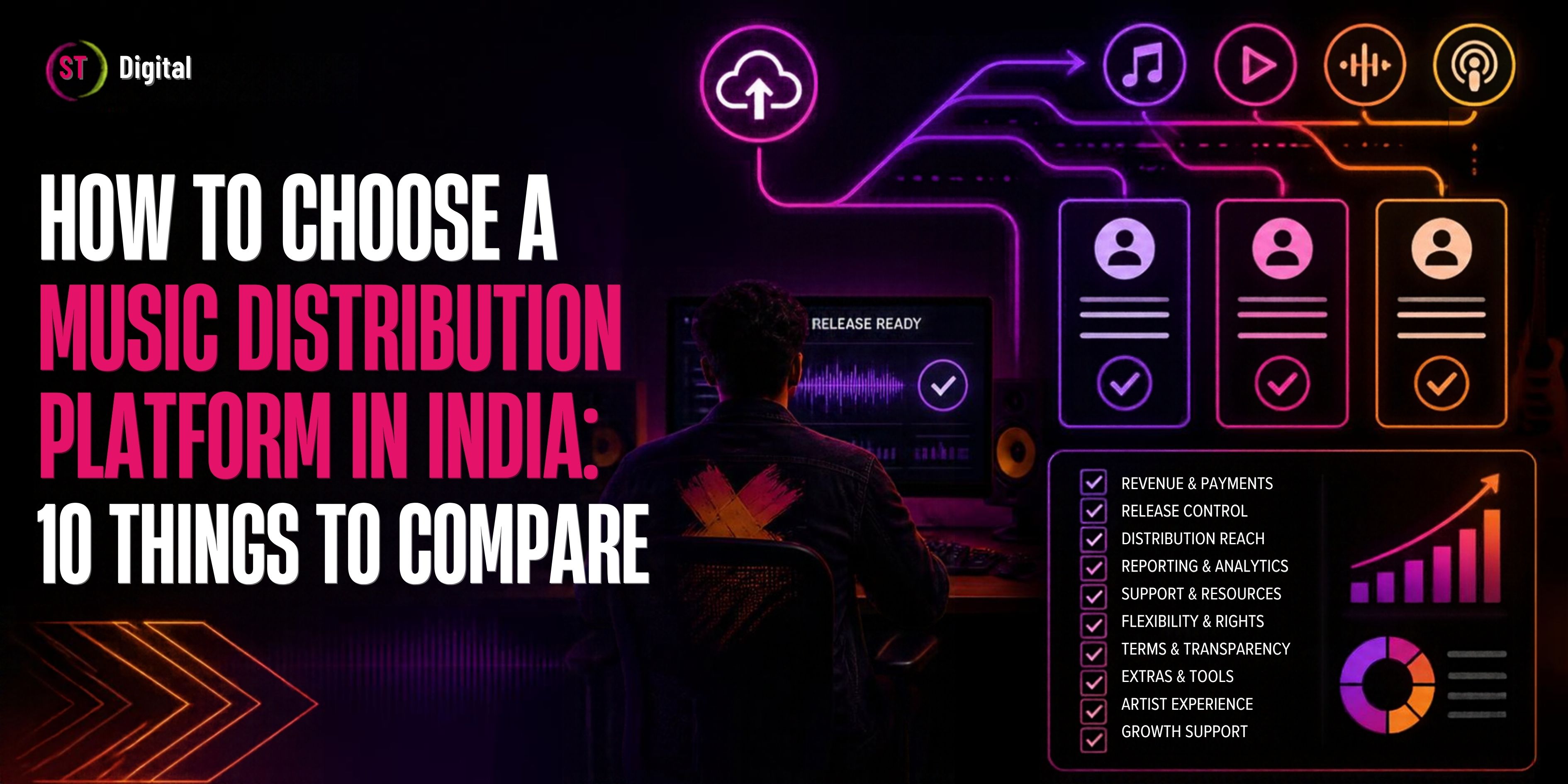
Before selecting a distributor, compare the following factors.
1. Platform availability
Check whether the distributor supports the streaming services and regional platforms where your target audience listens.
Artists in India may want to consider both international services and relevant Indian music platforms.
2. Transparent royalty terms
Understand how the distributor calculates and reports your earnings. Check the royalty split, applicable deductions and payment schedule.
3. Ownership and rights
Read the agreement carefully to understand ownership, licensing permissions, exclusivity, contract duration and the conditions for ending the arrangement.
Distribution does not automatically mean that you must transfer ownership of your music, but the agreement determines what permissions you grant.
4. Release and takedown policies
Check how much lead time is recommended before a release date. Also understand the process for correcting metadata, changing distributors or requesting a takedown.
5. Reporting and analytics
Choose a provider that gives you enough information to track your catalog's performance and understand reported earnings.
6. Support and reliability
Review the available support channels and processes for resolving delivery errors, incorrect artist profiles, missing releases and royalty-reporting questions.
7. Total cost
Calculate the full cost over 12 months, including subscriptions, per-release fees, commissions and optional services.
8. Terms for future growth
Your needs may change as your catalog grows. Check whether the distributor can support your future release schedule, additional artists or other required services.
Is Free Music Distribution Available Through ST Digital?
ST Digital advertises free music distribution in India through its music distribution service. Its website describes a process that includes account registration, uploading music, distribution to supported platforms and earnings reporting.
Artists can explore the ST Digital music distribution service to learn about the available features and current requirements.
Before registering, review the latest distribution agreement, eligibility conditions, platform availability, royalty arrangements and payment terms. Confirm that the service covers the release and monetization requirements for your particular project.
If you are preparing your first release, our guide on how to upload a song on Spotify in India explains the key steps involved in preparing and submitting music.
Artists who want to understand the broader financial side of releasing music can also read our guide to music royalties in India.
Common Mistakes to Avoid When Comparing Distribution Plans
Choosing only by price
A free service may be a good option, but you should still evaluate its royalty terms, support and platform reach.
Assuming paid distribution guarantees more streams
Distribution makes music available to supported platforms. It does not guarantee listeners, playlist placements or a successful promotional campaign.
Ignoring contract conditions
Read the terms for revenue sharing, licensing, exclusivity, cancellation and catalog transfers before committing.
Overlooking additional charges
Check for optional add-ons, payment fees, release charges and recurring subscriptions.
Confusing distribution with promotion
Distribution and promotion are different activities. A distributor delivers music to platforms, while promotion focuses on attracting listeners through marketing, content, advertising, press and audience engagement.
Failing to prepare release information correctly
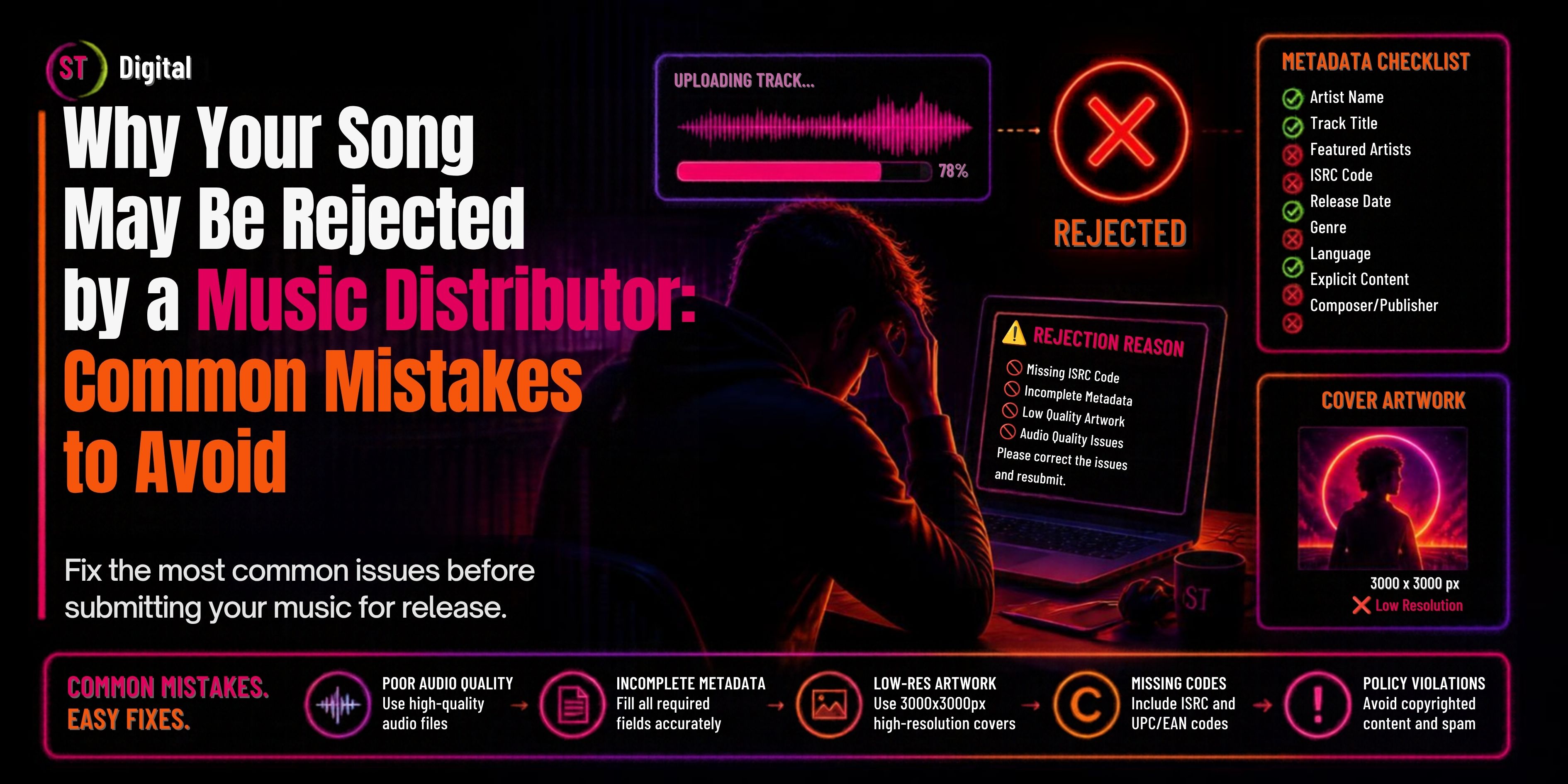
Incorrect artist names, missing credits, unsuitable artwork or inaccurate metadata can create delivery problems. Prepare your audio, artwork, credits and release details before submitting a track.
Final Thoughts
Choosing between free and paid music distribution comes down to your budget, release schedule and professional requirements.
Free distribution can be a sensible starting point for beginners and independent artists who want to release music while keeping upfront expenses low. Paid distribution may be worthwhile when its features, pricing structure or support provide clear value.
Before making a decision, compare the full cost, read the distribution agreement and understand how royalties, rights and catalog management work.
For independent artists, the goal is not simply to find the cheapest option. It is to find a reliable distribution partner that helps you release music professionally, reach the right audience and manage your music career with confidence.
Explore ST Digital's music distribution services to review its current offering and determine whether it fits your next release.
Frequently Asked Questions (FAQs)
1. What is the difference between free and paid music distribution?
Free distribution typically has no upfront distribution fee, while paid distribution may charge a subscription or per-release fee. Royalty arrangements, features and restrictions vary by provider.
2. Is free music distribution good for independent artists?
Yes. It can be a useful option for independent artists who want to release music without an upfront distribution expense. Artists should still review the agreement and any applicable revenue-sharing terms.
3. Does paid music distribution guarantee more streams?
No. Paying for distribution does not guarantee streams, playlist placements or higher earnings. Results depend on many factors, including audience interest, promotion and listener activity.
4. Can I earn royalties through free music distribution?
Yes, depending on the distributor's terms and the revenue generated by your eligible music. The amount paid to you depends on the applicable royalty arrangements and deductions.
5. Do free music distributors take a percentage of royalties?
Some do, while others advertise different arrangements. Check the distributor's current agreement to understand whether it retains a commission or applies other charges.
6. Can I distribute my music to Spotify without a record label?
Yes. Independent artists can use a digital distributor to submit music to Spotify and other supported services without signing with a traditional record label.
7. Is free music distribution available in India?
Yes. Some services, including ST Digital, advertise free music distribution in India. Availability and eligibility may depend on the distributor's current terms.
8. Should I choose a subscription or pay per release?
A subscription may suit artists who release frequently, while per-release pricing may suit those who release occasionally. Compare the total cost over your planned release schedule.
9. Can I change my music distributor later?
In many cases, artists can move their catalog to another distributor, but the process depends on the agreements and platform requirements involved. Check your current distributor's takedown policy, metadata requirements and transfer process before making a change.
10. What should I check before choosing a music distributor?
Compare platform reach, royalty terms, total costs, ownership and licensing conditions, analytics, customer support, payment policies and catalog-retention rules.

 October 18, 2026