Making music is an art, but understanding how that music generates income is an important part of building a sustainable career. Whether you are a singer, songwriter, composer, music producer or independent artist, knowing how music royalties work can help you understand your rights and earn from different uses of your music.
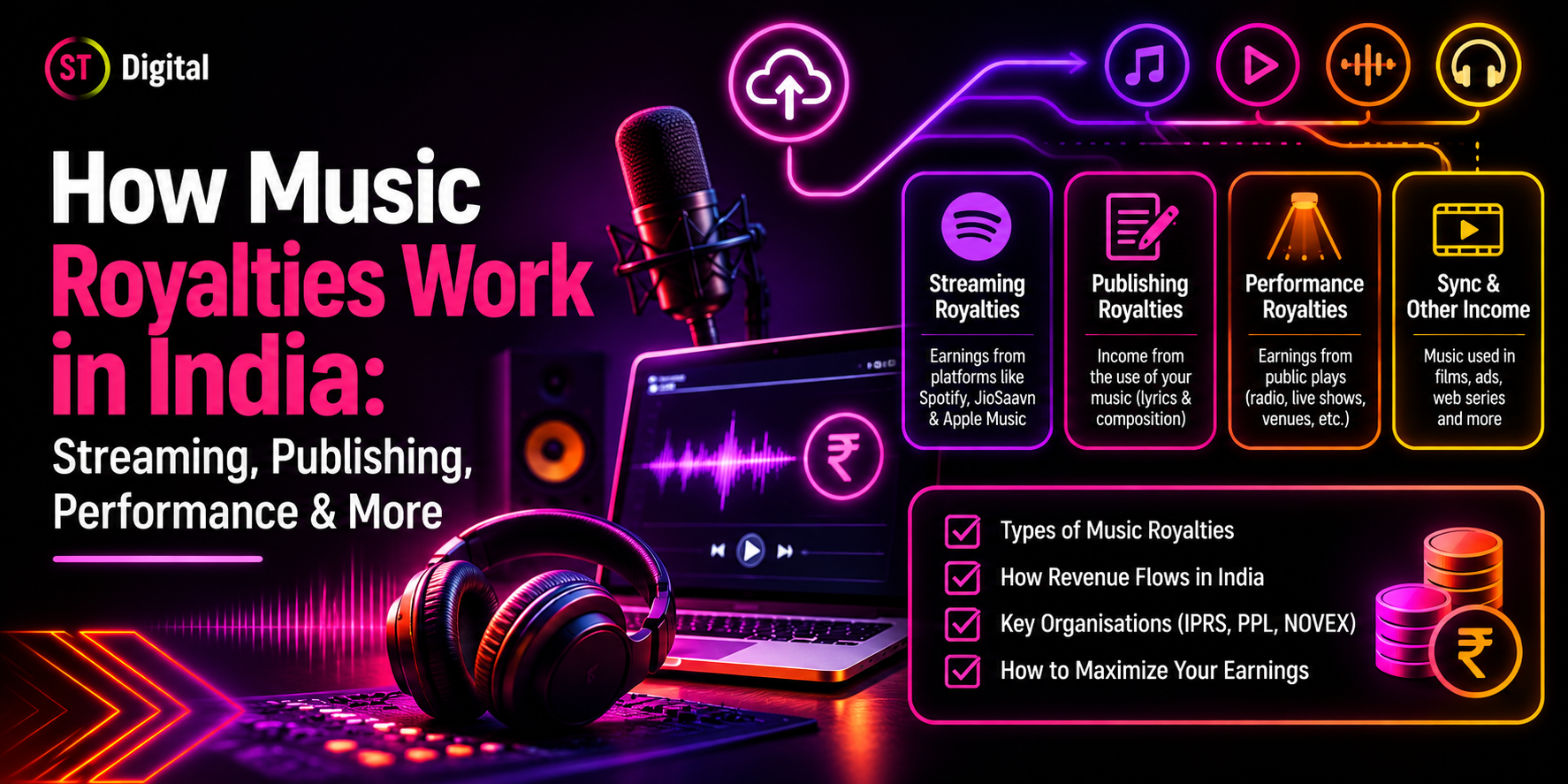
In India, a song can generate income through several channels, including digital streaming, music publishing, radio broadcasting, public performances, YouTube monetization, caller tunes and synchronization licensing.
However, many artists believe that their music distributor collects every type of royalty. This is not necessarily true. Different royalties relate to different rights, and payments may be collected by distributors, copyright owners, publishers and music rights organizations.
So, how do music royalties work in India?
This guide explains the different types of music royalties, the role of IPRS and PPL, how streaming and publishing payments work, and what independent artists should do to manage their music rights and earnings.
What Are Music Royalties?
Music royalties are payments made to the relevant rights holders when their music or recorded performances are used commercially under applicable agreements and copyright laws.
Whenever a song is streamed, broadcast, performed publicly, used in a film or advertisement, or otherwise commercially exploited, it may generate royalty income.
The person receiving the payment depends on the rights involved and the agreements governing the music.
For example:
A singer may earn from an eligible recorded performance and from agreements relating to the sound recording.
A lyricist may earn publishing royalties for the lyrics they create.
A composer may earn royalties for the musical composition.
A music publisher may receive its agreed share of publishing income.
A record label or independent recording owner may receive revenue from the sound recording.
The important point is that a single song can involve multiple copyrights and several different income streams.
Understanding the Two Main Copyrights in a Song
Before understanding music royalties, independent artists should know that a song generally involves two distinct copyright categories.
1. Sound Recording Rights (Master Rights)
The sound recording is the actual recorded version of a song. It includes the recorded performance, production and final audio master.
For example, when an artist records a Hindi song in a studio and releases the final audio file, that specific recording is the sound recording.
Depending on the circumstances and agreements, the owner may be:
Sound recording rights are important for digital distribution, recorded music licensing and certain public performance and broadcast uses.
2. Musical and Literary Work Rights (Publishing Rights)
Publishing rights relate to the underlying creative work rather than one particular audio recording.
They generally include:
For example, if a songwriter writes the lyrics and a composer creates the melody, their contributions form part of the underlying musical and literary works.
These rights are separate from the ownership of the final master recording.
Why does this distinction matter?
Imagine that your song is streamed on a digital platform. The recording may generate revenue for the owner of the master, while the underlying composition may generate separate publishing royalties for the relevant authors, composers and publishers.
The exact payment route depends on the platform, licensing arrangements and rights ownership.
Main Types of Music Royalties in India
Music royalties are not limited to streaming. Artists and rights holders may earn through several different sources.
Let's understand the major types.
1. Streaming Royalties
Streaming royalties are generated when music is played through digital streaming platforms such as:
Spotify
Apple Music
YouTube Music
Amazon Music
JioSaavn
Gaana
Wynk Music, where applicable under current service arrangements
Other supported digital music services
When listeners stream a song, the platform accounts for revenue according to its business model and licensing agreements.
The relevant recording revenue is generally paid through the rights holder's label or digital music distributor.
The underlying composition may also generate publishing income through applicable publishing arrangements.
How do streaming royalties work?
The typical process is:
An artist or rights holder distributes the recording through a digital music distributor.
The distributor delivers the recording to supported streaming platforms.
Listeners stream the song.
The platform calculates and reports eligible revenue under its agreements.
The distributor or relevant rights holder receives the applicable recording revenue.
The artist receives payment according to the distribution agreement.
Publishing royalties are handled separately according to the relevant rights, collection arrangements and agreements.
How much do artists earn per stream in India?
There is no fixed universal payment rate for every stream.
Streaming revenue can depend on:
The listener's country.
Whether the listener uses a free or paid subscription.
The platform's revenue and licensing model.
Total eligible streams and usage.
The rights involved.
Distributor commissions and contractual deductions.
For this reason, artists should be careful with websites or advertisements promising a guaranteed amount for every stream.
A stream count alone does not determine the final amount an artist receives.
2. Music Publishing Royalties
Music publishing royalties are generated from the use of the underlying musical composition and lyrics.
These royalties are particularly important for lyricists, composers and music publishers.
For example, if you write the lyrics of a song or compose its melody, you may have rights in the underlying musical or literary work, depending on the applicable agreements.
Publishing royalties may arise from:
What is IPRS?
The Indian Performing Right Society Limited (IPRS) is a copyright society in India that administers rights in musical works and literary works associated with musical works.
It represents eligible authors, composers and publishers and licenses relevant uses of those works.
IPRS collects royalties from licensed users and distributes eligible amounts according to its distribution rules, membership arrangements and applicable agreements.
For songwriters and composers, understanding IPRS membership and work registration is an important step towards managing publishing royalties.
Official website: https://iprs.org/
Who can receive publishing royalties?
Depending on the rights and agreements, publishing royalties may be payable to:
If multiple people contribute to a song, the agreed ownership shares and contractual arrangements are important.
How can songwriters register their works?
Artists and creators should:
Understand who owns the lyrics and composition.
Confirm their contribution and agreed ownership shares.
Review the relevant IPRS membership requirements.
Apply for the appropriate membership, if eligible.
Submit accurate work notifications and composition details.
Keep their contact and payment information updated.
IPRS provides separate membership information for authors, composers and publishers.
Useful resources:
3. Public Performance Royalties
Public performance royalties relate to music being played or performed in public under the applicable licensing arrangements.
Examples may include:
However, it is important to distinguish between the rights in the underlying composition and the rights in a recorded song.
A public use of recorded music can involve both the sound recording and the underlying musical and literary works. Separate rights and licensing arrangements may apply.
What is PPL India?
Phonographic Performance Limited (PPL India) is a copyright society that licenses sound recordings controlled by its member record labels for public performance and broadcast uses.
When a business or venue plays recorded music controlled by PPL, it may need the appropriate licence from PPL India.
PPL collects applicable licence fees and distributes revenue to the record-label rights holders it represents according to its distribution methodology.
Official website: https://www.pplindia.org/
What is the difference between IPRS and PPL?
The distinction is important:
OrganizationRights it administersIPRSMusical works and associated literary works, including compositions and lyricsPPL IndiaSound recordings controlled by its member labels
For example, when a commercially released song is played in a restaurant, the use may involve both the recorded master and the underlying composition.
A licence covering one category does not automatically cover the other.
Always confirm the relevant rights and licensing requirements for the particular use.
4. Performer Royalties
Performers contribute their voices, instruments and performances to recorded music.
Under India's Copyright Act, performers have legally recognized rights in their performances, subject to the provisions of the Act and applicable agreements.
Performers may include:
The Copyright Act, 1957, particularly Sections 38, 38A and 38B, deals with performers' rights and moral rights.
Section 38A recognizes certain exclusive rights in performances, while the Act also provides for royalty entitlement in specified circumstances involving commercial use.
Who can receive performer royalties?
Eligible performers may have rights to royalties when their performances are commercially exploited, depending on the circumstances, agreements and applicable law.
Performers should maintain accurate documentation of:
Their recorded contributions.
Performance agreements.
Credit information.
Ownership and royalty arrangements.
Permissions granted for commercial use.
Do not assume that being credited as a singer automatically makes you the owner of the master recording. Performer rights, master ownership and composition ownership are different matters.
Official legal reference: https://copyright.gov.in/Copyright_Act_1957/chapter_viii.html
5. Radio and Television Royalties
Music played on radio and television can generate income through applicable broadcasting and music licensing arrangements.
For example:
A radio station plays a recorded song.
A television channel uses music in a programme.
A broadcaster plays a song during an entertainment show.
These uses can involve rights in both the sound recording and the underlying musical and literary work.
The relevant rights holders and authorized organizations may collect royalties according to applicable licences and agreements.
For artists, it is important to ensure that their rights, credits and music information are correctly documented.
6. Synchronization (Sync) Royalties
Synchronization licensing, commonly called sync licensing, involves using music together with visual content.
Examples include:
A sync deal may involve two separate permissions:
Master-use permission: Permission to use the specific sound recording.
Composition-use permission: Permission to use the underlying musical composition and lyrics.
These permissions may be controlled by different rights holders.
For example, an independent artist who owns both the master recording and the composition may be able to negotiate both permissions, subject to any existing agreements.
A sync deal may include an upfront licensing fee. Additional royalties or payments may also arise depending on how the music is used and the terms of the agreement.
Why is sync licensing important?
Sync licensing can create opportunities for music to reach audiences through films, advertisements, television and digital content.
For independent artists, it can provide an additional income source beyond traditional streaming.
However, artists should ensure that all contributors have granted the necessary permissions before licensing a track.
7. YouTube Music and Content ID Revenue
YouTube can create different monetization opportunities for music rights holders.
It is important to understand the difference between YouTube Music distribution and YouTube Content ID.
YouTube Music distribution
A digital distributor can deliver an eligible audio release to YouTube Music.
This may result in official music content being made available through the YouTube music ecosystem, depending on the delivery arrangement.
YouTube Content ID
Content ID is a rights-management system that can identify matching copyrighted material in videos uploaded by users.
Eligible rights holders or their authorized representatives may use Content ID to manage matched videos through actions such as monetization, tracking or blocking, subject to YouTube's policies.
Artists should confirm whether their distributor offers Content ID administration and what conditions, fees or revenue-sharing terms apply.
Official resource: https://support.google.com/youtube/answer/2797370
8. Caller Tune and CRBT Royalties
Caller Ring Back Tone (CRBT), commonly known as caller tune service, allows mobile subscribers to select a song that callers hear when they dial their number.
In India, caller tune distribution can be another monetization opportunity for eligible music recordings.
The process generally involves:
Submitting the recording through a distributor that supports caller tune services.
Completing the required audio and metadata information.
Getting the release delivered to supported telecom or caller tune services.
Making the song available for selection by subscribers.
Receiving eligible revenue according to the applicable distribution agreement.
The actual availability and royalty arrangements depend on the distributor, telecom partner and current service terms.
Artists interested in this revenue channel can explore ST Digital's caller tune distribution service.
9. Live Performance Income and Royalties
Live performances can generate two different types of income that artists should not confuse.
Performance fees
When a singer performs at a concert, wedding, festival or private event, the artist may receive a performance fee from the organizer under their agreement.
This is a payment for providing the live performance service.
Music royalties
A live event can also involve royalties for the musical works performed, depending on the applicable rights, licensing and collection arrangements.
For example, IPRS administers rights in musical and literary works and has public-performance licensing arrangements.
A songwriter or composer may therefore have a separate royalty interest in the music performed, depending on their rights and the applicable distribution rules.
Receiving a performance fee does not automatically mean all music royalty rights have been settled.
Music Royalties in India: Who Collects What?
The following table gives an overview of common royalty streams and the relevant rights.
Royalty or income typeMain rights involvedTypical payment routeDigital streamingSound recordingDistributor or recording rights holderPublishing royaltiesComposition and lyricsIPRS or relevant publishing arrangementPublic performance of recordingsSound recordingRecording owner or authorized society such as PPLPublic performance of compositionsMusical and literary worksIPRS or relevant rights arrangementPerformer royaltiesRecorded performanceRelevant rights holder or authorized performer-rights arrangementRadio and television useRecording and composition rightsRelevant rights holders and licensing arrangementsSync licensingMaster and compositionRespective rights holders or authorized representativesYouTube Content IDEligible copyrighted recording/contentRights holder or authorized administratorCaller tunesRecording and applicable distribution rightsDistributor and service partnersLive performance feeArtist's live performance serviceEvent organizer or client
This is a general overview. Actual collection and payment routes depend on ownership, contracts, licensing arrangements and the type of use.
Example: How One Song Can Generate Multiple Royalties
Let's understand the different royalty opportunities through a simple example.
Imagine an independent artist creates a Hindi song.
The artist writes the lyrics.
A composer creates the melody.
A singer records the vocal performance.
A music producer creates the final master.
The recording is distributed to streaming platforms.
The song may generate several different income streams.
Scenario 1: The song is streamed on Spotify
The sound recording may generate recording revenue payable through the distributor or relevant recording rights holder.
The underlying composition may also generate publishing royalties through applicable licensing and collection arrangements.
Scenario 2: The song is played at a commercial venue
The use may involve the rights in the sound recording and the composition. The relevant licences and royalty arrangements depend on the rights controlled by the respective organizations.
Scenario 3: The song is used in an advertisement
The advertiser or production company may need master-use and composition-use permissions.
The relevant rights holders may negotiate a sync fee.
Scenario 4: The song is broadcast on television
The use may generate payments under applicable broadcasting and music licensing arrangements.
Scenario 5: A user uploads a video containing the song
If the recording is eligible and enrolled in Content ID through an authorized administrator, the rights holder may be able to monetize or manage the matched content under YouTube's policies.
The key lesson is that one song can generate multiple types of income, but each income stream depends on the rights involved and the applicable agreements.
How Can Independent Artists Collect Music Royalties in India?
Independent artists should not rely on a single account or organization to manage every type of royalty.
Instead, they should identify the rights they own and understand the appropriate collection routes.
Here are practical steps to get started.
Step 1: Identify your music rights
Determine whether you own:
If several people contributed, review the written agreements and ownership shares.
Step 2: Sign a clear distribution agreement
Choose a distributor that explains:
Which platforms it supports.
Which rights it administers.
Its royalty-sharing arrangement.
Payment schedules.
Applicable deductions.
Takedown and termination conditions.
Additional monetization services.
Step 3: Explore IPRS membership
If you are a lyricist, composer or music publisher, review the IPRS membership requirements.
Submit accurate work notifications and keep your membership information updated.
Step 4: Understand sound recording licensing
If you own a master recording, understand who administers its public performance, broadcast and other licensing rights.
If your recording is controlled by a label, check the agreement before assuming you can collect these royalties independently.
Step 5: Review performer agreements
Singers and musicians should keep copies of their recording and performance agreements.
Understand what rights you have granted and whether any royalty or other compensation arrangements apply.
Step 6: Maintain accurate metadata
Keep consistent information for every release, including:
Accurate metadata helps rights holders identify and allocate music usage correctly.
Step 7: Check your royalty statements
Regularly review reports from your distributor and other relevant rights organizations.
Compare the reported revenue, usage information, payment status and applicable deductions.
Common Music Royalty Mistakes Independent Artists Should Avoid
Many artists miss potential earnings because they do not fully understand music rights and royalty collection.
Here are common mistakes to avoid.
1. Assuming the distributor collects every royalty
A digital music distributor generally administers the revenue streams covered by its agreement. It does not automatically collect every publishing, performance or performer royalty.
2. Ignoring publishing rights
Lyricists and composers should understand the rights in their original creative contributions and review appropriate publishing administration options.
3. Not registering or notifying musical works
Accurate work information and appropriate registration or notification are important for royalty administration and allocation.
4. Signing agreements without reading them
Always review ownership, royalty splits, licensing permissions, exclusivity and contract duration.
5. Using incorrect metadata
Misspelled artist names, missing credits and incorrect identifiers can make it harder to match music usage to the correct rights holders.
6. Assuming every stream pays the same amount
Streaming revenue varies. Avoid relying on fixed per-stream payment claims.
7. Confusing master ownership with performer rights
A singer may have rights in their recorded performance without automatically owning the entire sound recording.
8. Ignoring sync opportunities
Artists who control their rights should consider making their music discoverable for film, television, advertising and other audiovisual opportunities.
How ST Digital Helps Artists with Music Distribution
Understanding royalties begins with understanding how your music reaches digital platforms and how your distribution agreement handles revenue.
ST Digital provides music distribution services for independent artists and music labels looking to release their music through supported digital platforms.
Through a digital distribution service, artists can explore opportunities to release their recordings, manage their music catalog and receive reporting according to the applicable service terms.
Before choosing a distributor, review:
Supported streaming platforms.
Recording royalty arrangements.
Payment and reporting policies.
Rights and licensing conditions.
Additional services such as caller tune distribution.
Applicable charges and deductions.
You can explore ST Digital's music distribution services to understand the current offering.
For additional monetization opportunities, visit ST Digital's caller tune distribution service.
Conclusion
Music royalties are an important part of building a sustainable career in the Indian music industry.
A single song can generate income through streaming, publishing, public performance, broadcasting, synchronization, YouTube monetization and caller tune services. However, these income streams are connected to different rights and may be collected through different organizations and agreements.
Independent artists should understand the difference between master recording ownership, composition ownership and performer rights. They should also maintain accurate metadata, review contracts and understand which services their distributor actually provides.
The goal is not simply to release a song. It is to understand the value of your music, protect your rights and make sure eligible revenue reaches the right people.
Explore ST Digital's music distribution services to learn more about releasing your music through digital platforms.
Frequently Asked Questions (FAQs)
1. 1. What are music royalties in India?
Music royalties are payments made to eligible rights holders when their music, recordings or performances are commercially used. They can arise from streaming, publishing, broadcasting, public performance, synchronization and other licensed uses.
2. 2. How do music royalties work in India?
Music royalties are generated when music is used under applicable licensing arrangements. Distributors, labels, publishers and copyright societies may collect different types of revenue and distribute payments according to ownership and agreements.
3. 3. What is the difference between streaming royalties and publishing royalties?
Streaming recording royalties relate to the sound recording, while publishing royalties relate to the underlying musical composition and lyrics. A single stream may involve both rights.
4. 4. What is IPRS, and what does it do?
The Indian Performing Right Society Limited (IPRS) is a copyright society that administers rights in musical works and associated literary works, including compositions and lyrics. It licenses relevant uses and distributes eligible royalties according to its rules.
5. 5. What is PPL India?
Phonographic Performance Limited (PPL India) licenses sound recordings controlled by its member labels for public performance and broadcast uses. It collects applicable licence fees and distributes revenue to the recording rights holders it represents.
6. 6. Do singers receive music royalties in India?
Singers may receive income through recording agreements, performer rights and other applicable arrangements. Their entitlement depends on the rights they hold, the agreements they sign and the commercial use of their performances.
7. 7. Do lyricists and composers receive royalties separately?
Lyricists and composers may receive publishing royalties for their contributions to the underlying musical and literary works. Their shares depend on ownership, agreements and applicable collection arrangements.
8. 8. How much does Spotify pay per stream in India?
Spotify does not have one fixed universal payment rate per stream. Revenue depends on several factors, including listener location, subscription type, overall platform revenue, licensing agreements and rights ownership.
9. 9. What are public performance royalties?
Public performance royalties relate to the use of music in public settings, such as commercial venues and events. Different rights may apply to the sound recording and the underlying composition.
10. 10. What are synchronization royalties?
Synchronization licensing involves using music with visual content, such as films, advertisements, web series and other audiovisual productions. It may require separate permission for the master recording and the underlying composition.
11. 11. How can I make sure I receive all the music royalties I am entitled to?
Identify your recording, composition and performer rights; maintain accurate metadata; review your distribution and publishing agreements; explore relevant IPRS membership; and regularly check royalty statements and payment records.

 November 16, 2026