When releasing music digitally, independent artists often come across three important terms: ISRC, UPC and Copyright. These terms may appear during music distribution, release registration or rights management, but they do not mean the same thing.
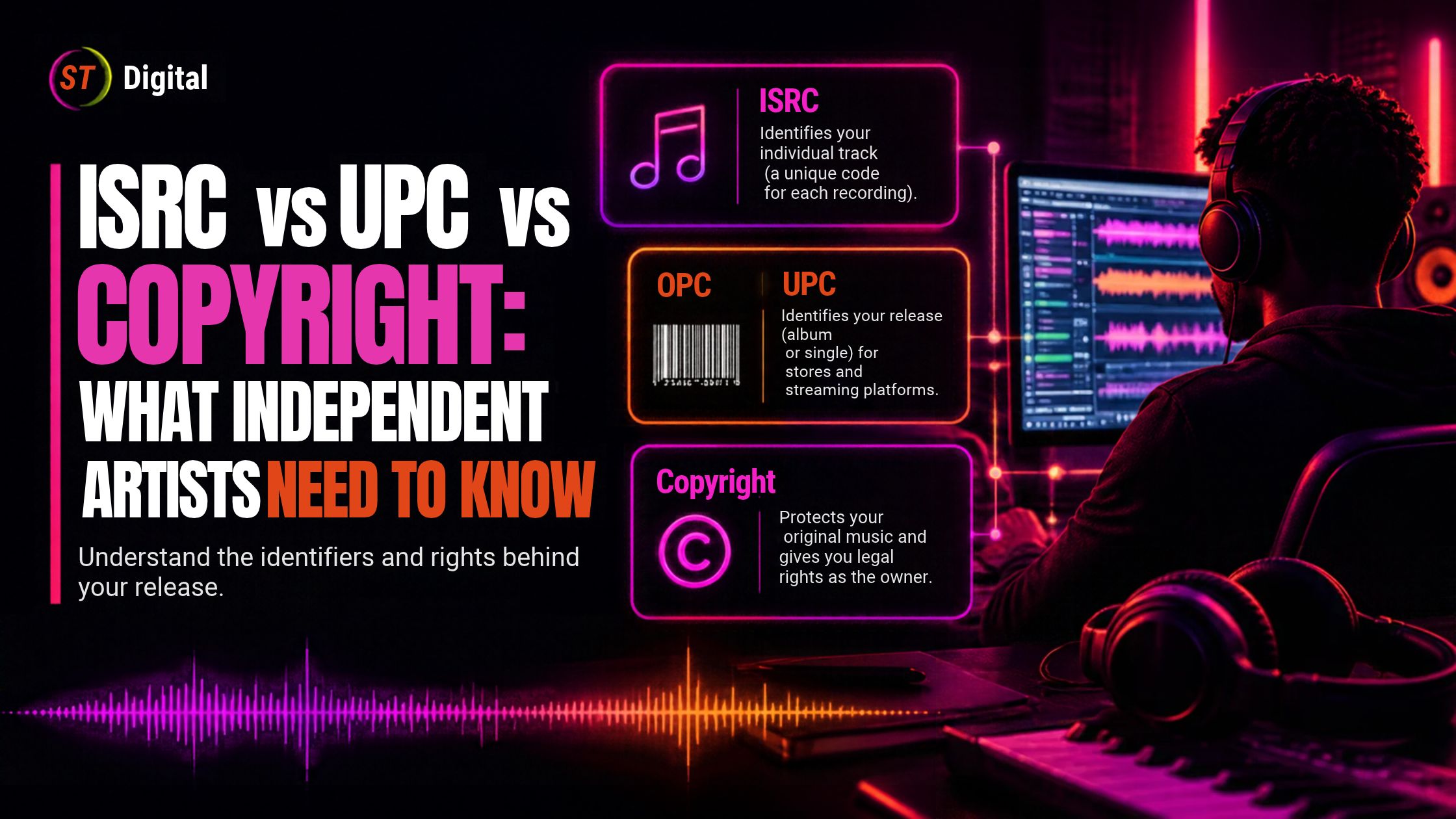
An ISRC identifies an individual sound recording. A UPC or EAN identifies a music release or product. Copyright, on the other hand, protects original creative work and gives the relevant rights holders legal control over its use.
Understanding the difference between ISRC vs UPC vs Copyright can help independent artists release music correctly, organize their catalogs, protect their rights and avoid common distribution mistakes.
In this guide, we will explain what each term means, how it works in India, when artists need it and how these three elements work together during music distribution.
What Is ISRC in Music Distribution?
ISRC stands for International Standard Recording Code. It is a unique identification code assigned to an individual sound recording or music video recording.
The code helps identify a particular recording across digital platforms, distribution services, broadcasting systems and rights-management databases.
For example, if an artist releases a studio version of a song, that recording can have its own ISRC. If the artist later releases a remix or a live version, those different recordings generally need separate ISRCs.
Why Is ISRC Important?
ISRC helps the music industry identify and track individual recordings.
Its main uses include:
Identifying individual sound recordings.
Distinguishing different versions of the same song.
Supporting music usage and royalty reporting.
Organizing music catalogs.
Helping platforms and distributors manage recording information.
Supporting rights administration across different markets.
An ISRC remains associated with the same recording when it is distributed through different platforms or channels.
What Does an ISRC Code Look Like?
An ISRC contains 12 alphanumeric characters.
A simplified example:
ISRC AA-6QZ-26-00047
Its structure contains:
ComponentMeaningPrefix codeIdentifies the registrantYear of referenceLast two digits of the year the code is assignedDesignation codeUnique five-character number assigned by the registrant
The example above is illustrative, not an actual code assigned to a release.
When Does an Artist Need an ISRC?
An artist generally needs an ISRC when distributing an individual sound recording or music video through services that require recording identification.
Examples include:
A new single.
An album track.
A remix.
An instrumental version.
A live recording.
A music video.
Important: An ISRC identifies a recording, not the songwriter, composer, performer or copyright owner.
The official ISRC system is administered internationally by IFPI. Independent artists can also assign ISRCs, subject to the applicable guidelines.
Official resource: https://isrc.ifpi.org/why-use-isrc/using-isrc
What Is UPC in Music Distribution?
UPC stands for Universal Product Code. In digital music distribution, a UPC or EAN is commonly used to identify a release or product, such as a single, EP or album.
While an ISRC identifies an individual recording, a UPC/EAN generally identifies the complete release.
For example, an album containing 10 songs can have one UPC/EAN for the album, while each of its 10 individual sound recordings has its own ISRC.
Why Is UPC Important?
A UPC/EAN helps distributors and digital platforms identify a music release.
It can be used for:
Identifying singles, EPs and albums.
Organizing release information.
Managing music catalog records.
Tracking a release across distribution systems.
Distinguishing different products or release configurations.
Example of UPC in Music Distribution
Imagine an independent artist releases an album called Journey containing five songs.
The release may have:
If the artist later releases one track as a separate single, that single may have its own release-level UPC/EAN while retaining the existing ISRC for the unchanged recording, subject to the distributor's delivery requirements.
Does Every Song Need a Separate UPC?
No. A UPC/EAN generally identifies the release rather than every individual track.
A single, EP and album are separate release products and may each have their own release identifier.
The exact identifier format and allocation process depend on the distributor and the applicable standards.
What Is Copyright in Music?
Copyright is a legal right that protects original creative works. In India, copyright protection is governed by the Copyright Act, 1957.
For music creators, copyright can apply to different parts of a song, including:
Copyright gives the relevant rights holders certain exclusive rights, subject to applicable law and exceptions.
Unlike ISRC and UPC, copyright is not simply a catalog identification code. It is a legal framework that protects creative work.
Does Copyright Exist Automatically in India?
Yes. Under Indian copyright law, copyright generally comes into existence automatically when an original work is created. Registration is not mandatory to acquire copyright.
However, copyright registration can provide useful documentary evidence. The registration certificate and entries in the Register of Copyrights serve as prima facie evidence in ownership disputes.
What Does Copyright Protect in a Song?
A song can involve multiple copyright works and contributors.
Music componentRelevant creator or rights holderLyricsLyricistMusical compositionComposerSound recordingProducer, subject to applicable ownership arrangementsRecorded performanceEligible performers may have performers' rights
The actual ownership and royalty arrangements depend on the circumstances, agreements and applicable law.
Why Should Independent Artists Understand Copyright?
Copyright knowledge helps artists:
Protect original music.
Understand who owns the master recording.
Clarify lyricist and composer rights.
Negotiate distribution and licensing agreements.
Manage permissions for commercial use.
Address unauthorized use of their music.
Understand potential royalty income.
Official resources:
ISRC vs UPC vs Copyright: Key Differences
The biggest difference is their purpose. ISRC and UPC/EAN are identifiers, whereas copyright is a legal right.
FeatureISRCUPC/EANCopyrightFull formInternational Standard Recording CodeUniversal Product Code / European Article NumberLegal rights in original creative worksMain purposeIdentifies a recordingIdentifies a release or productProtects eligible creative workIdentifiesIndividual sound recording or music videoSingle, EP, album or release productLyrics, composition, sound recording and other protected worksTypeIdentification codeProduct identification codeLegal rightAssigned or acquired throughISRC registrant or authorized managerDistributor, GS1 or relevant allocation arrangementArises automatically when legal requirements are metUsed forRecording identification and catalog managementRelease identification and catalog managementOwnership, licensing and protectionDoes it prove copyright ownership?NoNoCopyright establishes legal rights; registration can provide evidence
Remember: Having an ISRC or UPC does not automatically mean you own the copyright in a song.
ISRC vs UPC: Example for an Independent Artist
Let's understand the difference through a practical example.
Imagine an independent singer releases a three-track EP called New Beginnings.
The release contains:
Song A – Original studio recording.
Song B – Original studio recording.
Song C – Acoustic version.
The identifiers may be organized like this:
Release or trackIdentifierNew Beginnings EPOne UPC/EANSong AOne ISRCSong BOne ISRCSong C – Acoustic versionOne ISRC
The EP has one release-level identifier, while each individual recording has its own recording-level identifier.
The copyright in the lyrics, musical compositions and sound recordings is a separate matter. It depends on the relevant creators, ownership arrangements and agreements.
Can an Artist Release Music Without an ISRC or UPC?
This depends on the music distributor and its delivery requirements.
Many digital music distributors can assign or generate the required identifiers as part of their release process.
Some distributors allow artists to provide existing ISRCs or UPC/EANs when re-releasing music. Others may provide identifiers automatically for eligible releases.
Before submitting a song, check:
Whether the distributor assigns ISRCs.
Whether the distributor assigns UPC/EANs.
Whether you can provide your own existing codes.
Whether the codes can be retained during a catalog transfer.
Whether the same recording is being re-released or a new version is being delivered.
Do not create duplicate identifiers for the same recording or release without understanding the distributor's instructions.
Can You Reuse an ISRC for the Same Song?
An existing ISRC may generally be retained when the exact same sound recording is re-released or transferred to another distributor.
However, a new ISRC is generally needed when the recording is materially different, such as:
A new remix.
A newly recorded version.
A live version.
A substantially different edit.
A different recording of the same composition.
A simple metadata correction or change in distribution service does not necessarily mean a new ISRC is required.
Always check the official ISRC guidelines and your distributor's catalog-transfer requirements before assigning a new code.
Can You Change a UPC When Switching Music Distributors?
A release may sometimes retain its existing UPC/EAN when moving between distributors, depending on the release details and the receiving distributor's policies.
Before transferring your catalog, confirm:
Whether the new distributor supports existing UPC/EANs.
Whether the existing ISRCs can be retained.
Whether the release metadata will remain consistent.
Whether the original release will be taken down.
Whether the transfer could affect platform links, playlists or reporting.
Avoid uploading the same release as an entirely new product without first checking whether a catalog transfer is possible.
How to Get an ISRC and UPC for Your Music in India
Independent artists can obtain or manage music identifiers through eligible distribution services and the relevant identification systems.
Step 1: Prepare Your Music Release
Before submitting your release, prepare:
Step 2: Choose a Music Distributor
Select a distributor that supports the digital platforms where you want your music to be available.
Review its identifier policies, royalty terms, payment process and catalog-transfer options.
You can explore music distribution services to understand its current distribution offering.
Step 3: Submit Your Release Details
Enter the required metadata accurately.
If the distributor assigns ISRCs and UPC/EANs, follow its submission process. If you already have valid identifiers, provide them according to the distributor's instructions.
Step 4: Verify the Assigned Codes
Keep a record of:
Step 5: Maintain Your Music Catalog
Keep a master spreadsheet of your releases and identifiers. This will make future re-releases, distributor changes, royalty checks and catalog management easier.
Common Mistakes Artists Should Avoid
1. Confusing ISRC with UPC
An ISRC identifies an individual recording. A UPC/EAN identifies the release product. They are not interchangeable.
2. Assuming an ISRC Proves Copyright Ownership
An ISRC is an identification code, not a copyright certificate or ownership document.
3. Assigning a New ISRC to an Unchanged Recording
Reassigning identifiers unnecessarily can create catalog and reporting confusion.
4. Reusing an ISRC for a Different Recording
A remix, live version or materially different recording should generally have its own ISRC.
5. Entering Incorrect Metadata
Incorrect titles, artist names and credits can create problems in music catalog management and rights administration.
6. Ignoring Copyright Agreements
Before releasing a track, clarify who owns the master, lyrics and composition, and document the relevant permissions and royalty splits.
7. Not Maintaining Identifier Records
Keep a reliable record of all ISRCs and UPC/EANs. This is particularly useful when changing distributors or re-releasing music.
How ST Digital Helps Independent Artists Distribute Music
For independent artists, music distribution involves more than uploading an audio file. It also requires accurate metadata, release information and appropriate identification codes.
ST Digital offers music distribution services for artists and music labels looking to release their recordings through supported digital platforms.
Before submitting your music, review the current service terms and confirm:
Supported streaming platforms.
ISRC and UPC/EAN assignment or retention policies.
Metadata requirements.
Royalty reporting and payment terms.
Rights and licensing conditions.
Catalog-transfer support.
Explore ST Digital's music distribution service to learn more about releasing your music digitally.
You can also read our guide on how to upload a song on Spotify in India for a practical release walkthrough.
Conclusion
ISRC, UPC and copyright all play important roles in digital music distribution, but they serve different purposes.
ISRC identifies an individual sound recording.
UPC/EAN identifies a music release or product.
Copyright protects original creative work and establishes legal rights.
Independent artists should understand all three before releasing music. Keep accurate metadata, maintain a record of your identifiers, clarify ownership and review your distribution agreements.
A properly organized music catalog makes it easier to manage releases, transfer music between distributors and administer your rights as your career grows.
Ready to release your music? Explore ST Digital's music distribution services.
Frequently Asked Questions (FAQs)
1. What is the difference between ISRC and UPC?
An ISRC identifies an individual sound recording, while a UPC/EAN identifies a music release such as a single, EP or album. A release containing multiple tracks can have one UPC/EAN and separate ISRCs for its recordings.
2. Is ISRC the same as copyright?
No. ISRC is an identification code for a sound recording or music video. Copyright is a legal right that protects eligible creative work. An ISRC does not prove copyright ownership.
3. Is UPC mandatory for music distribution?
The requirement depends on the distributor and delivery process. Many distributors assign or generate a UPC/EAN for a release, while some allow artists to provide an existing identifier.
4. Does every song need a separate ISRC?
Each distinct sound recording generally needs its own ISRC. Different recordings, such as a studio version, remix or live version, should generally have separate codes.
5. Can I get an ISRC in India?
Yes. Independent artists and recording owners can obtain or assign ISRCs by following the applicable ISRC system guidelines and using eligible registration or distribution arrangements.
6. Can a music distributor provide ISRC and UPC codes?
Many music distributors provide ISRCs and UPC/EANs as part of their release-delivery process. Check the distributor's current policies before submitting your music.
7. Does an ISRC protect my song from copyright infringement?
No. An ISRC helps identify a recording, but it does not itself create copyright protection or prevent unauthorized use. Copyright law and the relevant ownership evidence are separate.
8. Is copyright registration compulsory in India?
No. Copyright generally arises automatically when an original work is created and the legal requirements are met. Registration is not mandatory, although it can provide useful evidence in ownership disputes.
9. Can I use the same ISRC after changing distributors?
The same ISRC can generally be retained when the exact same recording is transferred to another distributor. Confirm the transfer procedure with both distributors before making changes.
10. Can two different songs have the same ISRC?
No. An ISRC is intended to uniquely identify a particular recording. Different recordings should not be assigned the same ISRC.
11. Can one album have multiple ISRC codes?
Yes. Each individual recording on an album generally has its own ISRC. The album release itself generally has one UPC/EAN.
12. What happens if I enter the wrong ISRC or UPC?
Incorrect identifiers can create catalog, matching and reporting problems. Contact your distributor to correct the information rather than creating duplicate releases without guidance.
13. What should independent artists obtain before releasing a song?
Artists should prepare accurate release metadata, confirm the relevant music rights and permissions, and ensure that the release has the required ISRC and UPC/EAN identifiers according to their distributor's process.

 November 25, 2026