Choosing the right music distribution platform in India is an important decision for independent singers, musicians, producers, record labels and regional artists. The right platform can help you deliver your music to digital streaming services, manage releases, track earnings and reach listeners beyond your local market.
However, not every music distributor offers the same services, pricing structure, platform coverage, royalty terms or level of support.
Some distributors promote free music distribution, while others charge annual subscriptions, per-release fees or a share of your revenue. Some offer additional tools for analytics, rights management and catalog transfers, while others focus primarily on delivering music to streaming platforms.
So, how do you choose the best option for your music career?
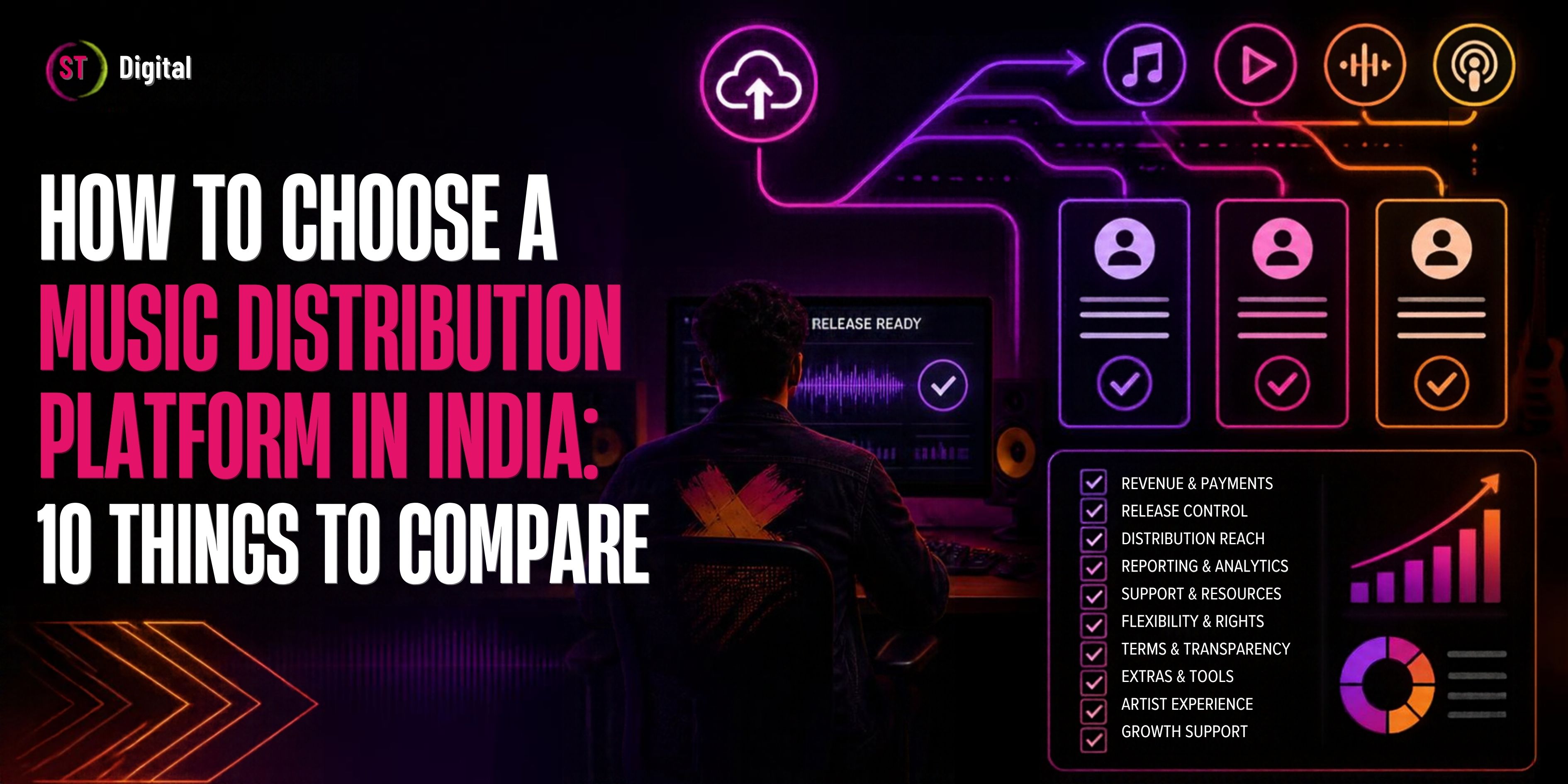
In this guide, we'll explain 10 important things to compare before choosing a music distribution platform in India, helping you make an informed decision based on your goals, budget and release strategy.
What Is a Music Distribution Platform?
A music distribution platform connects artists and record labels with digital music services.
Instead of submitting your music individually to every streaming service, you can use a distributor to deliver your releases to the platforms it supports.
Depending on the service, music distribution may include:
Delivering singles, EPs and albums to streaming platforms
Managing release information and metadata
Uploading cover artwork and audio files
Assigning or managing recording identifiers
Providing royalty reports
Helping artists manage their catalogs
Offering distribution support
Providing access to additional music services
For independent artists, digital distribution creates opportunities to release music without necessarily signing with a traditional record label.
If you want to understand how this independent model works, read our guide to music distribution without a record label.
10 Things to Compare When Choosing a Music Distribution Platform in India
1. Digital Platform Coverage
The first thing to check is where the distributor can deliver your music.
A distributor may support major international streaming platforms, regional Indian services, social-media music libraries and other digital outlets. However, availability varies by distributor, territory and service agreement.
Before choosing a platform, check whether it supports the services relevant to your target audience.
These may include:
Spotify
Apple Music
YouTube Music
Amazon Music
JioSaavn
Gaana, where available through the distributor
Instagram and Facebook music libraries
TikTok music services, where supported
Other regional and international platforms
Don't select a distributor based only on the total number of platforms it advertises.
Instead, ask whether it delivers to the specific services where your listeners are most likely to discover your music.
What to compare:
Supported streaming platforms
Regional Indian platform availability
International distribution
Social-media music library delivery
Availability by country and territory
2. Distribution Fees and Hidden Charges
Pricing is one of the most important considerations for independent artists.
A music distributor may offer free distribution, a paid subscription, a per-release payment or a revenue-sharing arrangement.
Each model has different advantages.
Pricing modelWhat to checkFree distributionWhether any revenue share, limitations or additional charges applyAnnual subscriptionRenewal price and what happens if you stop payingPer-release feeCost for each single, EP or albumRevenue sharingPercentage retained by the distributorAdditional servicesCharges for optional services or premium features
A platform advertising free distribution may still have specific contractual terms or limitations. Similarly, a paid distributor isn't automatically better simply because it charges a fee.
Calculate the total cost over time and read the agreement before deciding.
For example, if you release several singles and albums every year, a per-release model could produce a different total cost from a subscription model.
What to compare: Initial fees, recurring charges, commission, renewal terms, optional services and cancellation conditions.
3. Royalty Rates and Payment Transparency
Before choosing a music distributor, understand how your earnings are calculated and paid.
Streaming platforms generally calculate royalties according to their applicable agreements and reporting systems. The amount an artist receives can vary based on platform, territory, usage, rights ownership and other factors.
Your distributor may then apply its own contractual revenue-sharing or fee structure.
Check the following:
What percentage of revenue do you receive?
Does the distributor retain a commission?
Are there minimum payout thresholds?
How frequently are payments processed?
Which payment methods are supported?
Are taxes, platform charges or other deductions applicable?
Can you access detailed royalty statements?
Be careful with promises of guaranteed earnings or fixed amounts per stream. Streaming revenue is not necessarily a universal fixed rate.
A transparent distributor should explain its payment terms clearly.
What to compare: Revenue share, reporting detail, payout schedule, minimum payout, deductions and payment conditions.
4. Ownership Rights and Contract Terms
Your music is a valuable creative asset. Before signing up with any music distribution platform in India, understand exactly what rights you grant the service.
Pay particular attention to whether the agreement concerns distribution rights, master ownership, licensing, exclusivity or other permissions.
Important questions include:
Do you retain ownership of your master recordings?
What distribution rights are granted?
Is the agreement exclusive?
How long does the agreement last?
Can you remove or transfer your music?
What happens when you close your account?
Are there restrictions on distributing the same recording elsewhere?
What happens to earnings after termination?
Do not assume every distributor uses the same agreement.
Read the current terms carefully, especially if you own your masters or plan to transfer your catalog in the future.
What to compare: Ownership, license scope, exclusivity, contract duration, takedown terms and catalog-transfer conditions.
5. Ease of Use and Release Management
A distribution platform should make it reasonably straightforward to submit and manage your releases.
An overly complicated workflow can waste time, particularly if you release music regularly or manage several artists.
Check whether the platform allows you to:
Create and manage releases
Upload audio and cover artwork
Enter metadata and contributor credits
Choose supported digital platforms
Set release dates
Review submission status
Manage multiple tracks or albums
Access previous releases
A good workflow should also make it clear when a release needs correction or additional information.
If you manage a label or multiple artists, ask whether the service supports your catalog-management requirements.
What to compare: Dashboard usability, upload process, release tracking, catalog management and the availability of helpful instructions.
6. Release Processing Time and Reliability
Your release schedule matters.
If you plan a music video, promotional campaign, influencer collaboration or social-media launch, delays in distribution can disrupt your plans.
However, no distributor can guarantee that every release will go live at exactly the same time across every service.
Processing may depend on submission quality, review requirements, platform delivery and the release date selected.
Before choosing a platform, find out:
How early should you submit a release?
How are submission errors communicated?
Can you track delivery status?
How are corrections handled?
What happens if a platform delays a release?
Is support available for urgent release problems?
Avoid uploading your song at the last minute.
Give yourself enough time for review, corrections and promotional preparation.
What to compare: Submission workflow, status tracking, communication about delays and guidance on release planning.
7. Royalty Reports and Analytics
Distribution gets your music onto digital platforms, but reporting helps you understand its performance.
A useful dashboard may show earnings and usage information reported by supported services.
Depending on the distributor and available data, reports may include:
Revenue by platform
Revenue by territory
Track-level performance
Reporting periods
Catalog earnings
Downloadable statements
Historical reports
These insights can help you understand which releases are performing well and where your audience may be growing.
For example, if your Punjabi song receives a significant share of its reported streams from listeners outside India, you may consider creating more promotional content for those audiences.
Remember that reporting is not always real-time. Streaming platforms and distributors may have different reporting schedules.
What to compare: Reporting detail, update frequency, historical data, export options and earnings visibility.
8. Customer Support and Problem Resolution
Customer support becomes especially important when something goes wrong.
You may need help with:
Before choosing a music distributor, understand how you can contact its support team.
Check whether it provides email support, a help center, account assistance or another clearly documented support channel.
Also look for clear instructions on resolving common release issues.
Don't judge support solely by promotional claims. Read the terms of service and evaluate whether the available support matches your requirements.
What to compare: Contact methods, response expectations, issue-resolution process and account assistance.
9. Additional Services and Monetization Opportunities
Some distributors provide more than basic audio delivery.
Depending on the provider, additional services may include:
Music video distribution
YouTube Content ID administration
Caller tune or CRBT distribution
Music publishing administration
Lyrics distribution
Rights-management tools
Social-media music delivery
Promotional tools
White-label distribution technology
These services are not included with every distributor, and their availability may depend on eligibility, licensing and separate terms.
For Indian regional artists, caller tune distribution may be relevant. Artists interested in video monetization may want to investigate supported video and rights-management services.
However, don't pay for features you don't need.
Choose a platform based on the services that support your actual music strategy.
What to compare: Included features, eligibility, additional costs, territory coverage and the terms governing each service.
10. Catalog Transfers and Long-Term Flexibility
Your music catalog may grow over several years.
You might begin by releasing singles and eventually move to EPs, albums or managing releases for other artists.
A distributor should fit your long-term plans rather than just your next release.
Consider whether you can:
Maintain existing recordings and identifiers during a transfer
Access previous release information
Retrieve historical royalty reports
Understand the takedown process
Move your catalog to another provider
Continue managing rights after leaving the service
Catalog transfers need careful handling. Incorrect metadata or identifiers can create duplicate listings or other catalog issues.
Before switching providers, confirm the procedure with both distributors and understand any contractual restrictions.
What to compare: Transfer support, takedown procedures, identifier continuity, historical reports and exit conditions.
How to Compare Music Distribution Platforms: A Practical Scorecard
Use this scorecard to compare the services you are considering.
Give each distributor a score from 1 to 5 for each factor. A higher score means the service better meets your requirements.
FactorWhat to evaluateScorePlatform coverageRelevant Indian and international services/5PricingTotal cost and additional charges/5RoyaltiesClear revenue and payment terms/5RightsOwnership and contractual flexibility/5Ease of useUpload and release management/5ProcessingWorkflow and status updates/5AnalyticsUseful reporting and data access/5SupportHelp with release and account issues/5Additional servicesRelevant monetization options/5Catalog flexibilityTransfer and exit conditions/5TotalMaximum score/50
This scorecard is a decision-making tool, not an industry ranking.
A platform with the highest score may not automatically be the best choice for you. Give extra importance to the factors that matter most to your budget, release frequency and music career.
Which Music Distribution Platform Is Best for Independent Artists in India?
There is no single platform that is best for every artist.
Your ideal choice depends on your goals.
If You Are Releasing Your First Song
Look for a straightforward upload process, clear instructions, reasonable costs and accessible support.
You may not need advanced catalog-management features at this stage.
If You Release Music Frequently
Compare subscription costs, per-release fees, catalog management, reporting and renewal conditions.
A small difference in pricing can become significant when you release music regularly.
If You Are a Regional Artist
Check distribution to the services relevant to your audience, along with support for your language, metadata and release requirements.
Artists creating Hindi, Punjabi, Rajasthani, Haryanvi, Bhojpuri and other regional music should evaluate both Indian and international distribution opportunities.
If You Manage Multiple Artists
Look for suitable account-management tools, catalog organization, reporting and support for label workflows.
Also review whether the agreement permits the way you intend to manage and distribute recordings.
If You Want to Grow Internationally
Check worldwide delivery, territorial availability, reporting by market and the ability to manage your catalog over time.
Global distribution can make music available to international audiences, but it does not guarantee streams, playlist placements or earnings.
Why Consider ST Digital for Music Distribution?
ST Digital offers a music distribution service for artists and labels seeking to deliver their music to supported digital platforms.
According to its published service information, ST Digital offers global distribution, a free distribution option, earnings reporting, account support and a process for submitting singles, EPs and albums.
Before choosing any service, including ST Digital, review its current features, pricing, agreement and eligibility requirements to confirm they match your needs.
You can explore the ST Digital music distribution service to learn more about its offering.
The right distributor should provide a clear process for submitting music and help you understand the commercial terms before you release your catalog.
Common Mistakes to Avoid When Choosing a Distributor
Choosing Only Because It Is Free
Free distribution can be useful, especially for new artists. However, you should still compare revenue-sharing terms, service limitations, rights and additional charges.
Ignoring the Contract
Never assume you retain every right or can switch distributors without restrictions. Read the agreement first.
Believing Guaranteed Streaming Promises
Distribution makes music available; it does not guarantee streams, playlist placements or viral success.
Overlooking Support
A low-cost service may not suit you if its support arrangements don't meet your needs.
Ignoring Catalog Transfers
If you plan to change providers, understand how existing recordings, identifiers, release information and royalty reports will be handled.
Comparing Only the Number of Platforms
A long list of destinations is less useful if the distributor does not support the specific services that matter to your audience.
Final Checklist Before Choosing Your Music Distribution Platform
Before registering, confirm the following:
The distributor supports the platforms relevant to your audience.
The complete pricing model is clear.
Revenue-sharing and payment terms are understandable.
Your master ownership and distribution rights are clear.
Contract duration and termination conditions are acceptable.
The upload and release-management process meets your needs.
Reporting provides useful earnings information.
Support is available through a documented channel.
Additional services are relevant to your goals.
Catalog-transfer and takedown conditions are understood.
If you cannot find an answer to an important question, contact the distributor before uploading your music.
Conclusion
Choosing a music distribution platform in India requires more than comparing prices or looking at the number of streaming services listed on a website.
You should evaluate platform coverage, costs, royalty terms, rights, ease of use, processing, analytics, support, additional services and long-term catalog flexibility.
Independent artists need a distributor that fits their current budget while supporting their future plans.
Take time to compare your options, review the agreement and understand how your music and earnings will be managed.
Once you've selected a suitable platform, prepare your audio, artwork, metadata and release schedule carefully. Then combine distribution with a consistent promotional strategy to give your music the best opportunity to reach new listeners.
Frequently Asked Questions (FAQs)
1. What is a music distribution platform in India?
A music distribution platform helps artists and labels deliver their recordings to supported digital music services. Depending on the provider, it may also offer release management, royalty reporting and other services.
2. How do I choose the best music distributor in India?
Compare platform coverage, total costs, revenue-sharing terms, ownership rights, reporting, support, release processing and catalog-transfer conditions. Choose according to your goals rather than promotional claims alone.
3. Is free music distribution available in India?
Yes, some distributors advertise free music distribution. However, check the current terms to understand any revenue share, limitations, additional charges or eligibility requirements.
4. Do music distributors take a percentage of royalties?
Some distributors retain a percentage of revenue, while others charge subscriptions or per-release fees. The arrangement depends on the provider and your agreement.
5. Can independent artists distribute music without a record label?
Yes. Independent artists can use digital distributors to deliver music to supported platforms without necessarily signing with a traditional record label.
6. Can I change my music distributor later?
Often, artists can transfer their catalogs, but the process depends on contractual terms and distributor requirements. Check takedown procedures, identifiers, metadata and reporting before making the switch.
7. Does music distribution guarantee Spotify streams?
No. Distribution makes your music available through supported services, but streams depend on listener discovery, audience engagement, promotion and other factors.
8. Should I choose a distributor based on the number of platforms?
Not exclusively. Compare the specific services you need, pricing, rights, reporting and support alongside overall platform coverage.
9. What should I check in a music distribution agreement?
Review ownership, licensing rights, exclusivity, revenue sharing, payment terms, contract duration, takedown procedures and catalog-transfer conditions.

 October 7, 2026